
Klepzig Mill: A Quiet Testament in the Ozarks
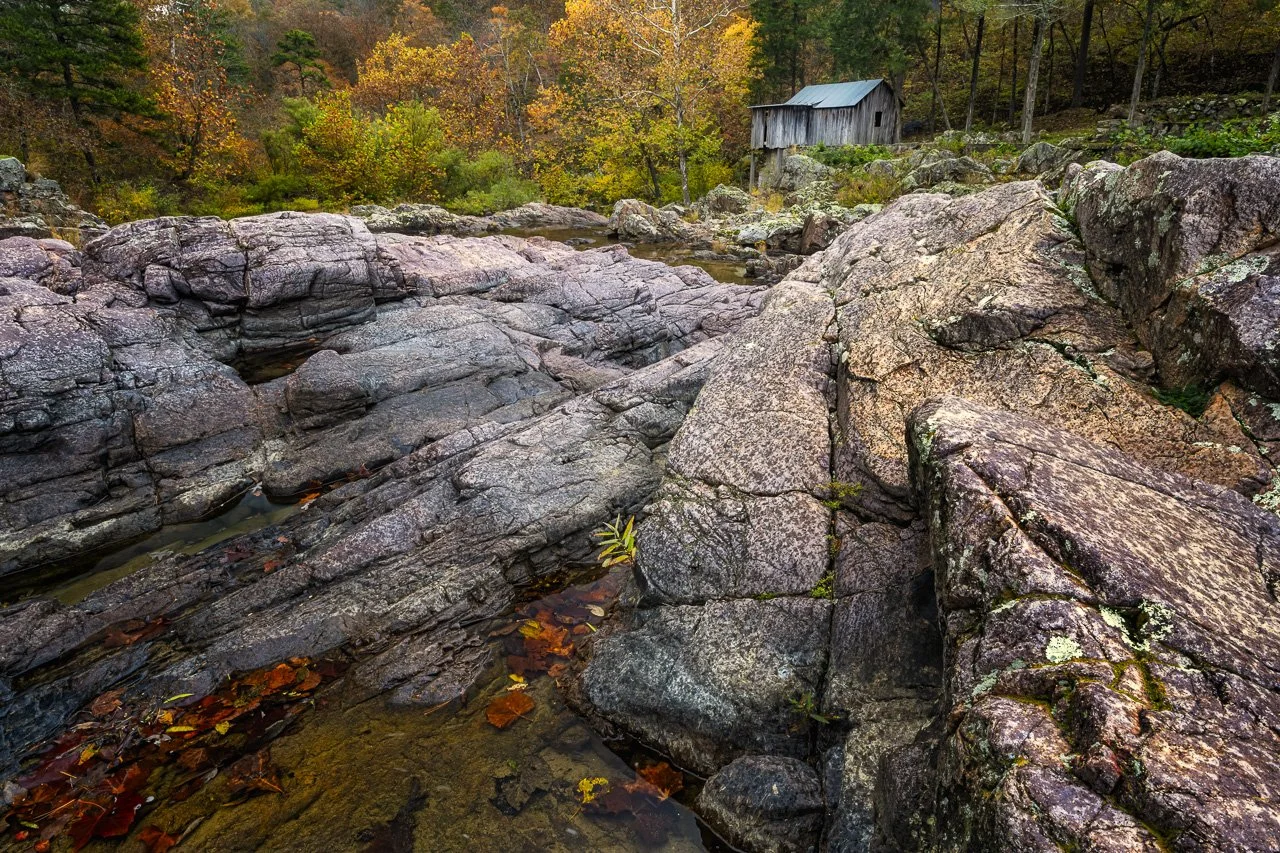
Tucked deep within the rhyolite folds of Rocky Creek, Klepzig Mill stands as a weathered witness to ingenuity, resilience, and community. Built in 1928 by Walter Klepzig, the mill is more than a relic — it’s a story etched in stone, timber, and water.
A Mill with a Mission

A wide-angle perspective of Klepzig Mill beside Rocky Creek.
Pentax 67, SMC 55mm, F/22, 1/15 sec, Kodak Ektar 100.
Walter Klepzig didn’t just build a mill — he built a lifeline. From a remote fold in Shannon County, he fenced his fields with barbed wire, bred milk cows with purpose, and shipped cream north to Nebraska. But the real story ran deeper than commerce. He ground corn for neighbors “on starvation,” saved the straightest boards for coffins, and raised homes from the logs he sawed — each cut a quiet act of care.
The mill itself, built in 1928, was a patchwork of necessity: vertical planks nailed to hand-hewn sills, unmortared stone piers, and a roof stitched together with corrugated iron and salvaged Model A truck parts. It stood not as a monument, but as a gesture — humble, functional, and generous.
Much of this history is preserved through the National Park Service’s documentation of Klepzig Mill, part of the Ozark National Scenic Riverways. But the spirit of the place lives in the stillness between the stones, in the way water carves through rhyolite, and in the stories that linger long after the last board was sawn.
A Landscape of Shut-Ins and Stillness
Rocky Creek doesn’t rush — it threads. Winding through a canyon of Precambrian rhyolite, the water slips into narrow corridors carved by time and turbulence. These shut-ins — natural sluices of stone — shape the creek’s voice: soft in the eddies, sharp in the plunge. They’re not dramatic in scale, but they’re precise in character, offering a rhythm of flow and fracture that feels both ancient and immediate.
Klepzig Mill sits just upstream, quiet as a held breath. Its weathered boards and patched roof echo the landscape’s language — utilitarian, enduring, and unadorned. Here, motion meets stillness. The creek moves with purpose; the mill holds its ground. Together, they form a dialogue between erosion and craftsmanship.
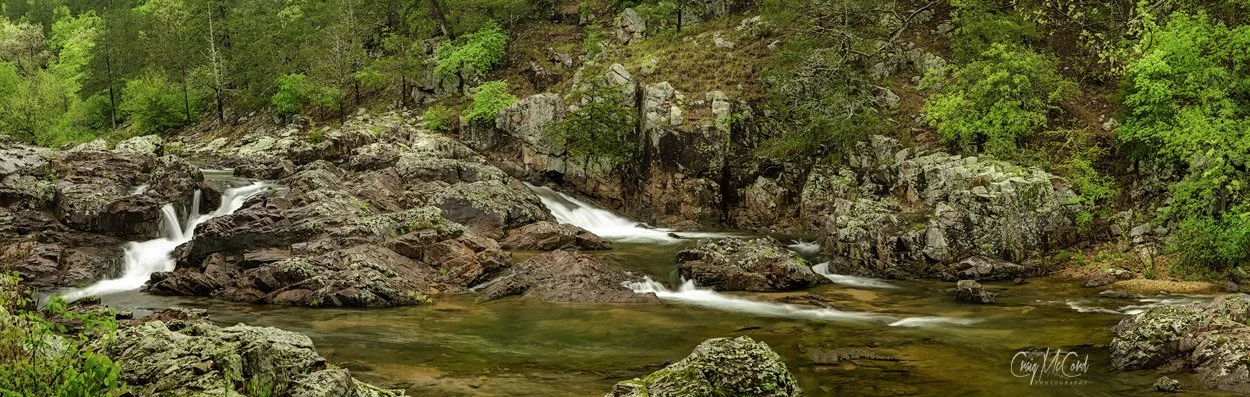
Rocky Creek cascading over shut-ins into a pool adjacent Klepzig Mill
Architecture of Necessity
Klepzig Mill wasn’t built to impress — it was built to endure. Raised in 1928 by Walter Klepzig, the structure reflects a kind of Ozark pragmatism: vertical pine planks nailed to hand-hewn sills, unmortared stone piers anchoring it to the creek’s edge, and a roof patched with corrugated iron and salvaged truck parts. Every element speaks to resourcefulness. Nothing wasted. Nothing ornamental.
This was a sawmill house — a style born from access to lumber and the need for speed. As sawmills replaced log cabins, families built upright, plank-sided homes that could be raised quickly and repaired often. Klepzig’s version was more than shelter. It was a workshop, a gathering place, a quiet engine of survival.
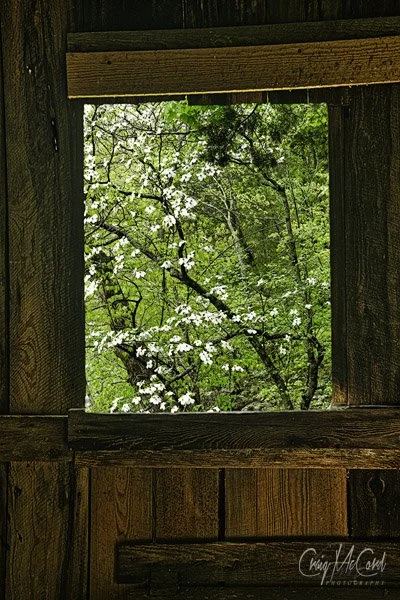
From inside the mill a view of spring dogwood blooms
The mill’s footprint is modest, but its legacy is layered. It’s listed on the National Register of Historic Places and preserved as part of the Ozark National Scenic Riverways. Yet its significance isn’t just in the designation — it’s in the way it still stands, weathered but intact, a testament to care, craft, and community.
Still Standing
Klepzig Mill doesn’t announce itself. There’s no sign, no parking lot, no paved trail. Just a narrow dirt road off Highway NN, a bend in Rocky Creek, and the hush of stone and timber. You arrive not by accident, but by intention.
I remember those early attempts to locate the mill—no signage, just a brief, somewhat inaccurate description from a book I’d brought along. The directions led me down rough, rutted gravel paths and dirt tracks so narrow I nearly had to reverse out. It wasn’t until my third visit that I met a local couple camping by the Current River who kindly pointed me in the right direction. These days, it’s far simpler. A sign now marks the end of Hwy NN where the pavement gives way to gravel, directing travelers left at the fork. From there, the mill lies just 1.5 miles down that narrow road.
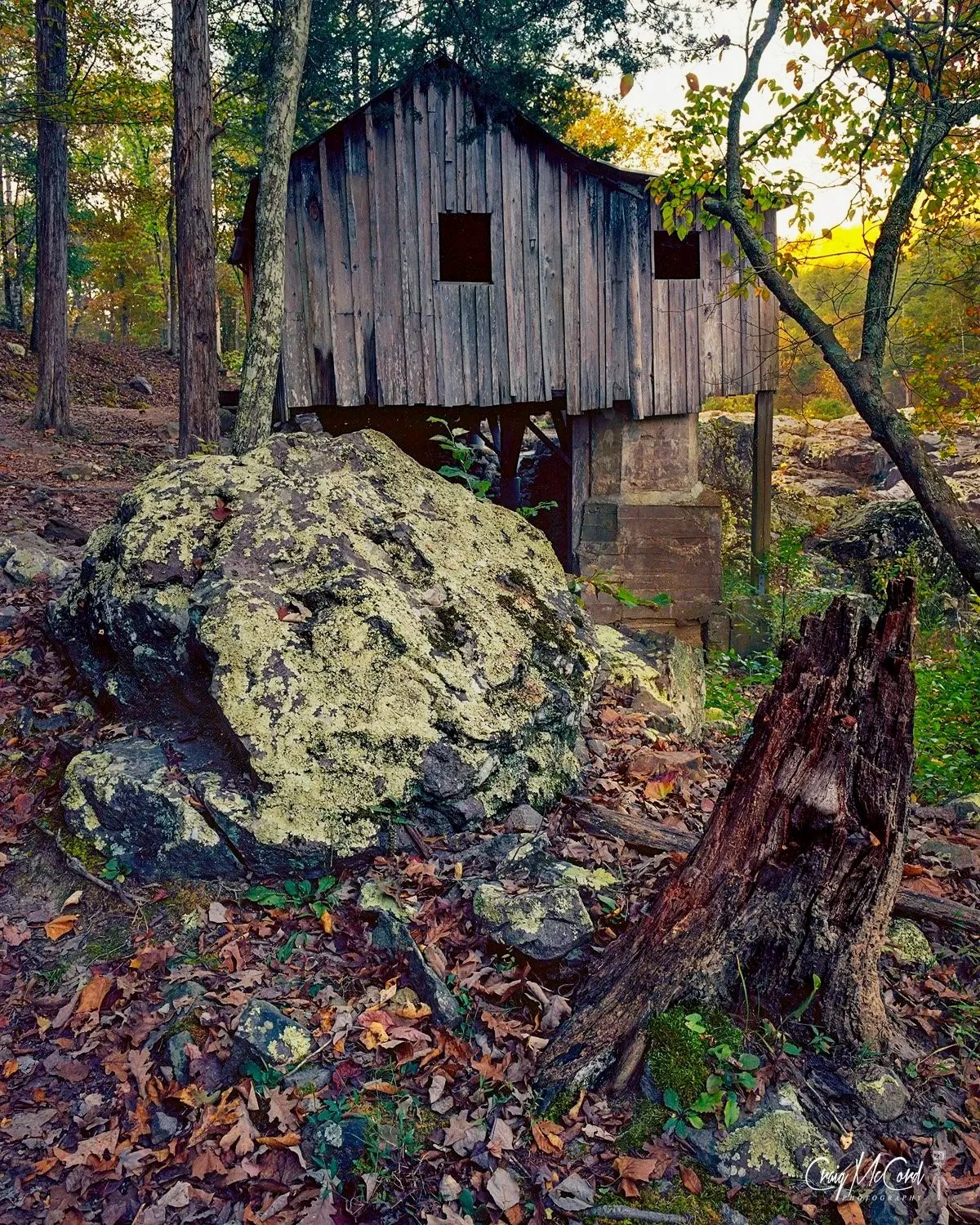
Klepzig Mill stands quietly above Rocky Creek, supported by stone and concrete. Fallen leaves, and lichen covered boulder, and a decaying stump mark the sloping and rugged foreground.
What remains is modest: a structure weathered by time, a creek still carving its way through rhyolite, and a story that lingers in the grain of the boards. It’s not a ruin. It’s a rhythm — of labor, of generosity, of land meeting hand.
For those who find it, Klepzig Mill offers more than a photograph. It offers a pause. A chance to listen to the landscape, to trace the lines of care etched into wood and water. And maybe, if the light is right, to see how stillness can speak.
This is, without a doubt, one of my absolute favorite spots to photograph while exploring the Missouri Ozarks. I truly enjoy capturing different perspectives as I climb atop the massive granite boulders along Rocky Creek. Each time I visit, the scene feels fresh and unique. The creek’s varying water levels consistently reveal new and intriguing ways to frame and photograph this historic mill, making every visit a rewarding experience.