
Hocking Hills: Erosion, Light, and Memory
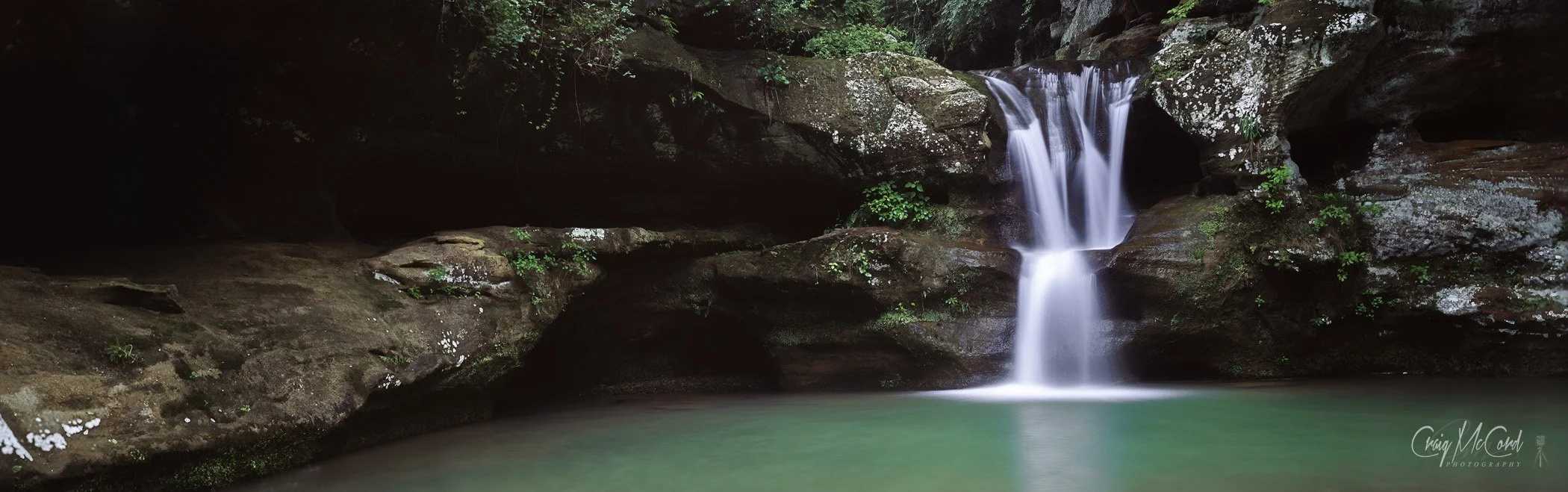
Upper Falls, Old Man’s Cave Trail

Time Wears Gold
Cantwell Cliffs in autumn light, showing vertical sandstone striations and young trees with golden foliage.
Zone VI 4x5, Fuji Velvia, exposure details unrecorded.
Tucked into the sandstone spine of southeastern Ohio, Hocking Hills is a place where water gently carves deep silence into ancient stone formations. I was first introduced to this beautiful and photo-rich area in the late 1980s, shortly after becoming an Ohio resident. At that time, having recently developed a more serious passion for my photography, I began making regular trips to Hocking Hills to hike its trails, explore its hidden corners, and capture the unique beauty of this geologically rich and inspiring landscape.
Hocking Hills State Park has undergone a remarkable transformation over the past 30 years—from a beloved regional retreat to one of the most visited and celebrated natural destinations in the entire Midwest. When I first began visiting the area, it was relatively unknown outside of Ohio and primarily enjoyed by locals. Although access to the parks and trails remains open year-round, visitation back then was mostly seasonal, especially the Fall.
What Changed
Over the years the rise of digital photography and travel blogs began showcasing the park’s dramatic sandstone formations, waterfalls, and caves to a wider audience. Lodging options expanded, and social media exposure to a wide audience certainly added to its appeal. During a recent visit I was told by a local Logan, Ohio business owner that the area now sees over 4 million visitors a year from all over.
Reasons for the Growth
Since 2021 the area is now among the top 10 fastest-growing state parks in the US. No doubt the increase can be attributed to number of things, not the least of which is social media, web searches, and the growth and popularity of digital photography.
Hocking Hills has also benefited from strong keyword performance. Searches like “best hikes in Ohio,” “waterfall trails near me,” and “cabins in nature” consistently surface the park in top results.
Covid-19 contributed to growth as well. With indoor activities restricted, outdoor recreation became a safe haven. Hocking Hills’ cabin-based lodging and trail accessibility made it ideal for socially distanced travel. During the pandemic many of the trails were designated one-way to limit potential virus exposure. These policies remain in effect, not now so much for Covid issues, but it just makes for efficient visitor flow during peak visitor hours.
A Few Hocking Gems
Cedar Falls
One of my favorites among many has to be Cedar Falls. While there are a number of waterfalls in the Hocking Hills Park system, there is something unique about this waterfall for me. Cedar Falls is tucked into a gorge that muffles sound and filters light. That quietude—paired with the steady roar of water—can evoke a sense of solitude, introspection, or even reverence.
Depending on recent rainfall, the flow can range from a gentle veil to a roaring curtain. The latter most often after Spring rains. But even at its most subdued, it maintains a sense of gravity—pulling the eye downward through texture and tone.
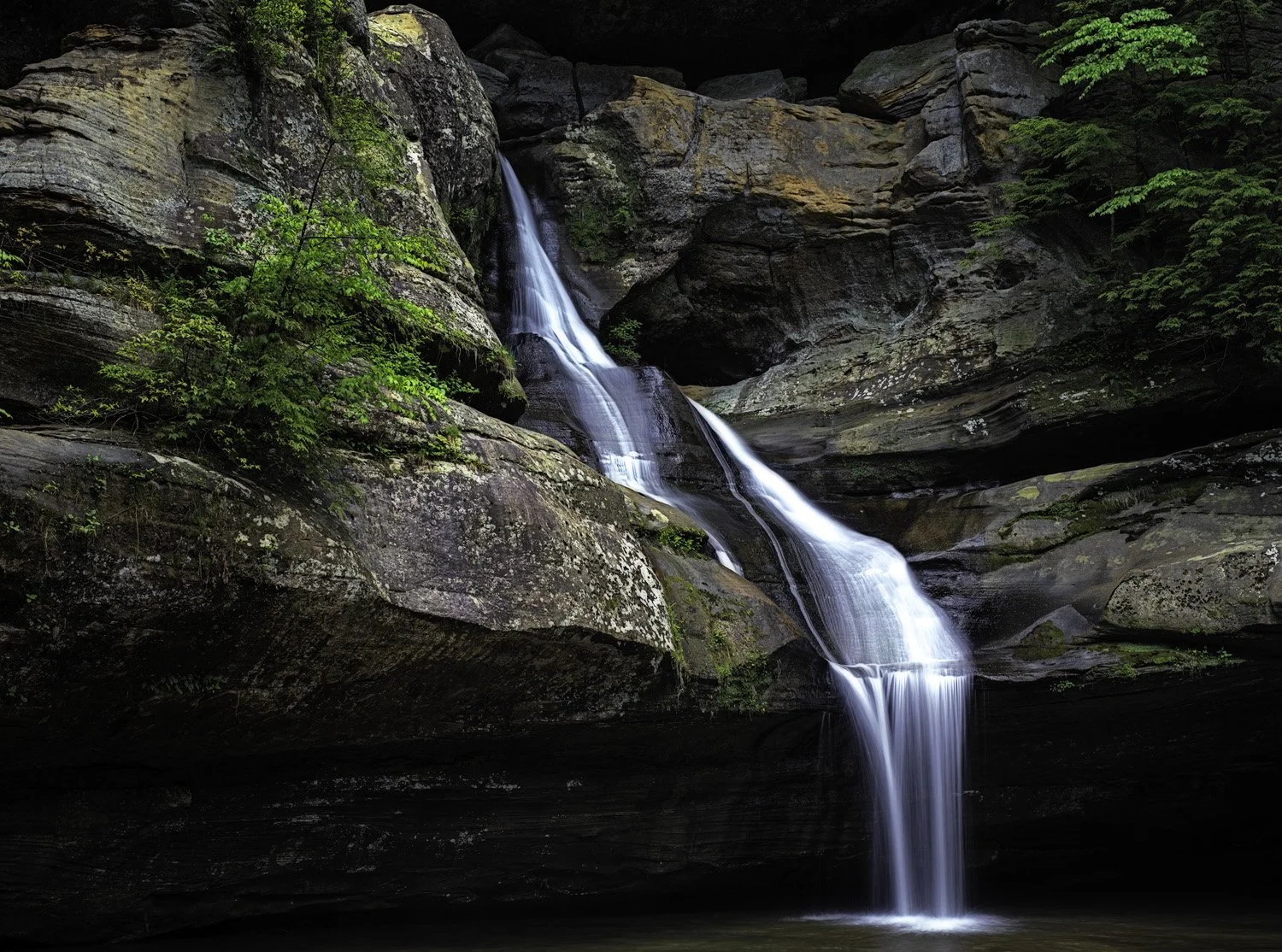
Split Decent
At Cedar Falls, water divides with intention—two streams carving through sandstone ledges shaped by centuries of erosion. The cascade is forceful yet measured, descending into a still pool that mirrors the gorge’s quiet gravity.
Upper Falls
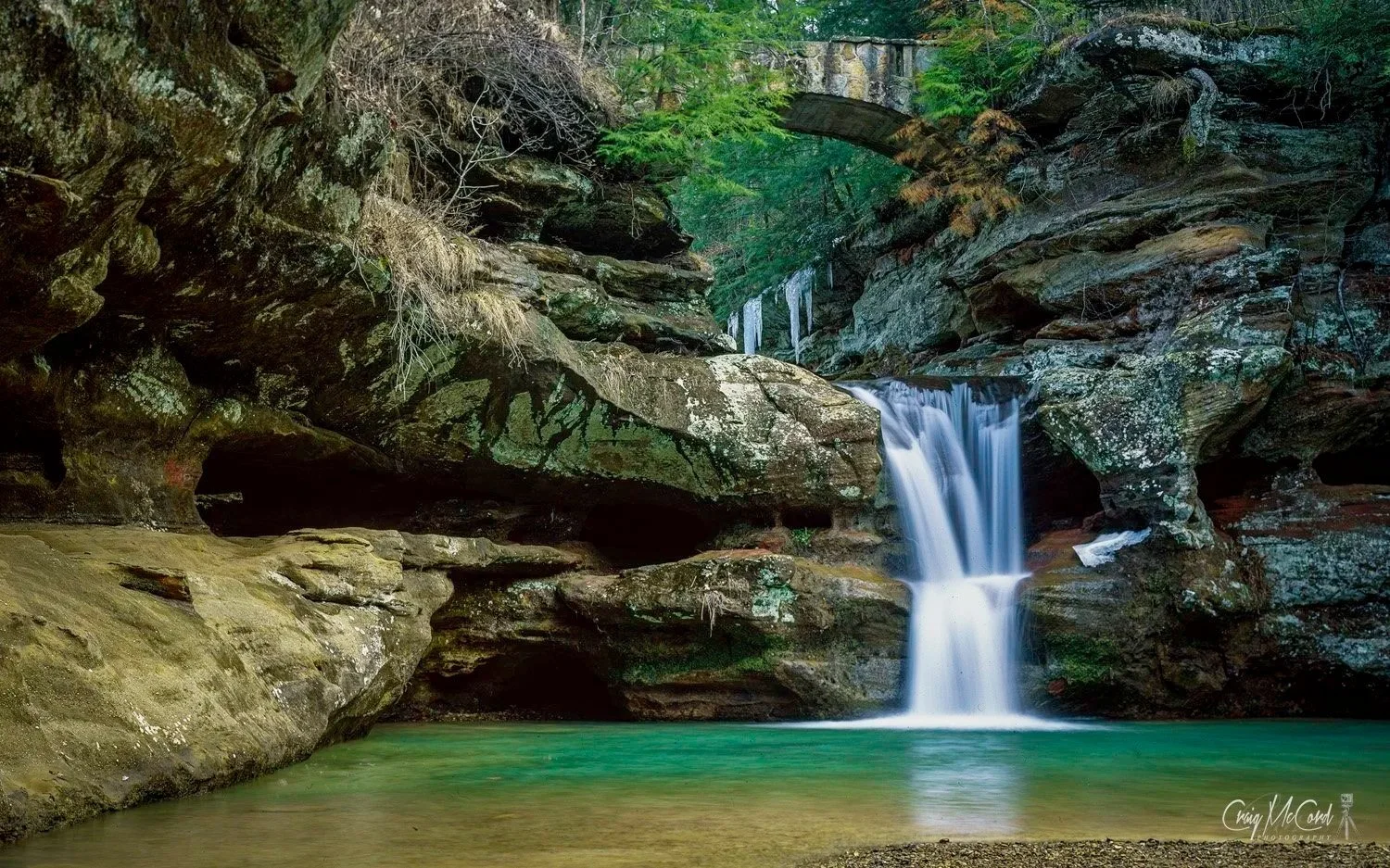
At Upper Falls, water emerges from a narrow crevice and descends in two deliberate tiers—each shaped by centuries of erosion and seasonal flow. The turquoise pool below holds the scene in quiet tension, reflecting both motion and stillness.
Zone VI 4x5, Velvia 50, 2 sec, f/32
As you begin your descent into Old Man’s Cave Trail from the visitor center, the journey opens with a quiet architectural gesture—a stone bridge arching over Upper Falls. From this vantage, you glimpse the cascade’s upper tier emerging from a narrow crevice, framed by sandstone ledges and the natural stone arch above. It’s a moment of anticipation, where water begins its sculptural descent into the gorge.
Continuing down into the lower area, the scene unfolds into a dynamic compositional environment. The waterfall’s second tier widens and drops into a turquoise pool, surrounded by moss-covered rock formations and layered textures that invite both wide-angle and intimate framing. The interplay of vertical motion and horizontal stillness offers photographers a study in contrast—ideal for exploring shutter speed variations, tonal separation, and depth cues.
Depending on the season and time of day, light filters through the canopy in shifting patterns, casting highlights across the water’s surface and revealing subtle details in the stone. Reflections in the pool can be used to double the visual impact or to isolate abstract forms. The stone arch above acts as a natural frame, allowing for narrative-driven compositions that suggest passage, shelter, or geological time.
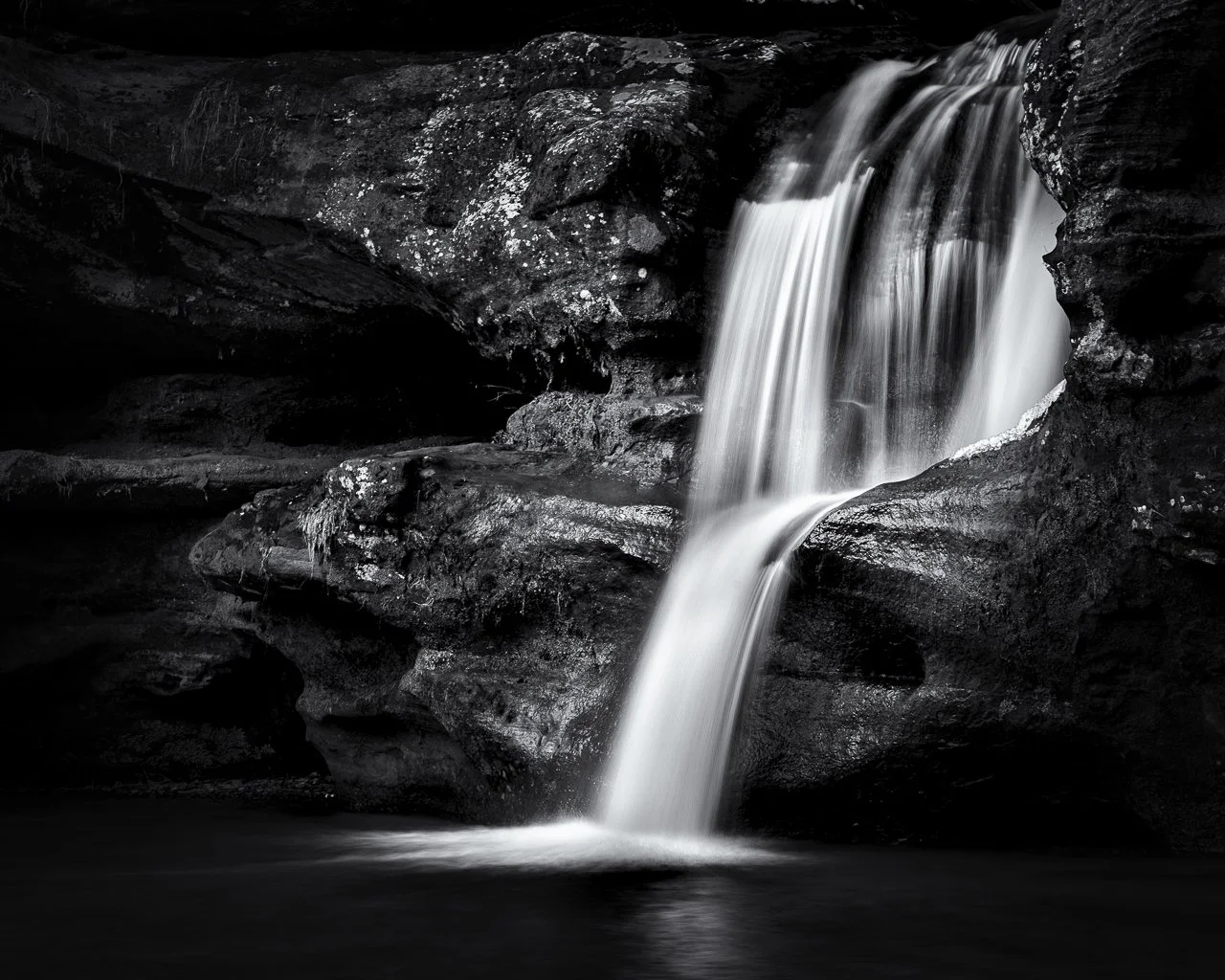
Upper Falls Detail
Monochrome allows for stronger emphasis on shape and structure. The vertical descent of the falls, the horizontal layering of stone.
Don’t discount the option for black and white photography. The layered rock formations, with their striations and lichen and moss-covered surfaces, gain prominence in monochrome. Without color to distract, the viewer is drawn into the tactile qualities of erosion and time.
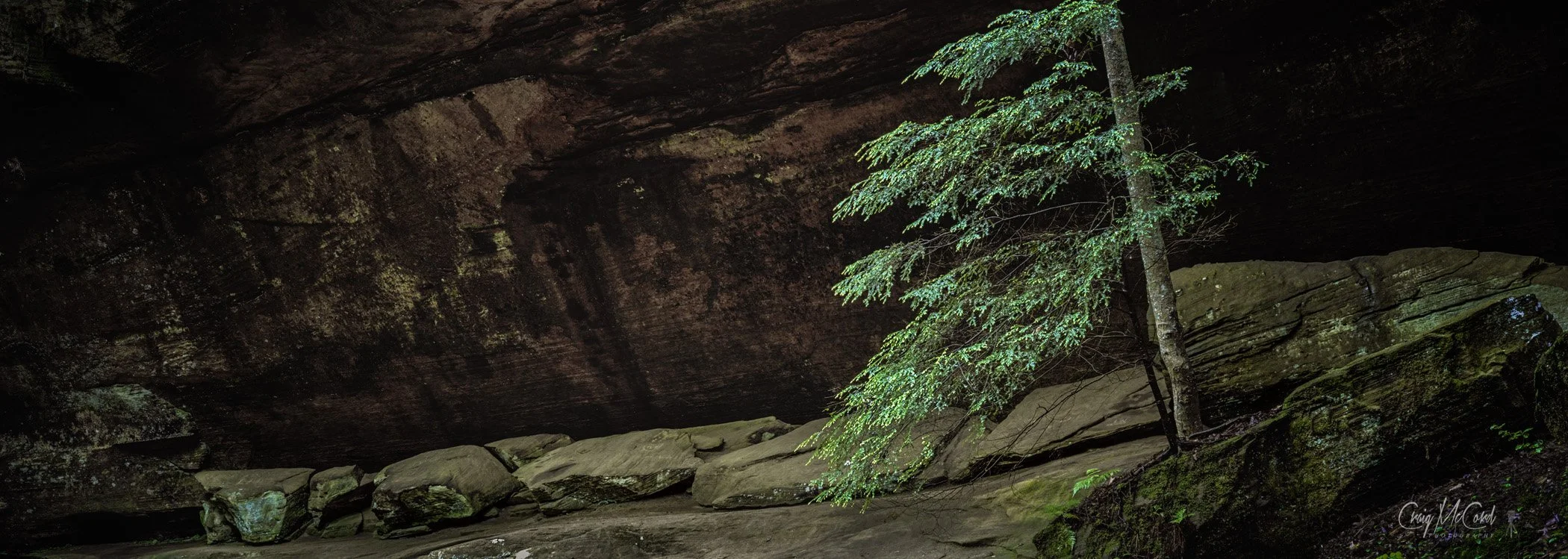
Rock Shelf and Young Hemlock
Mineral-stained sandstone and lichen covered rocks at the edges of Queer Creek offer intimate detail shots along Old Man’s Cave trail.
Shen Hao PTB 6x17, 210mm, Fuji Provia 100f, f/32, 1sec.
Lower Falls
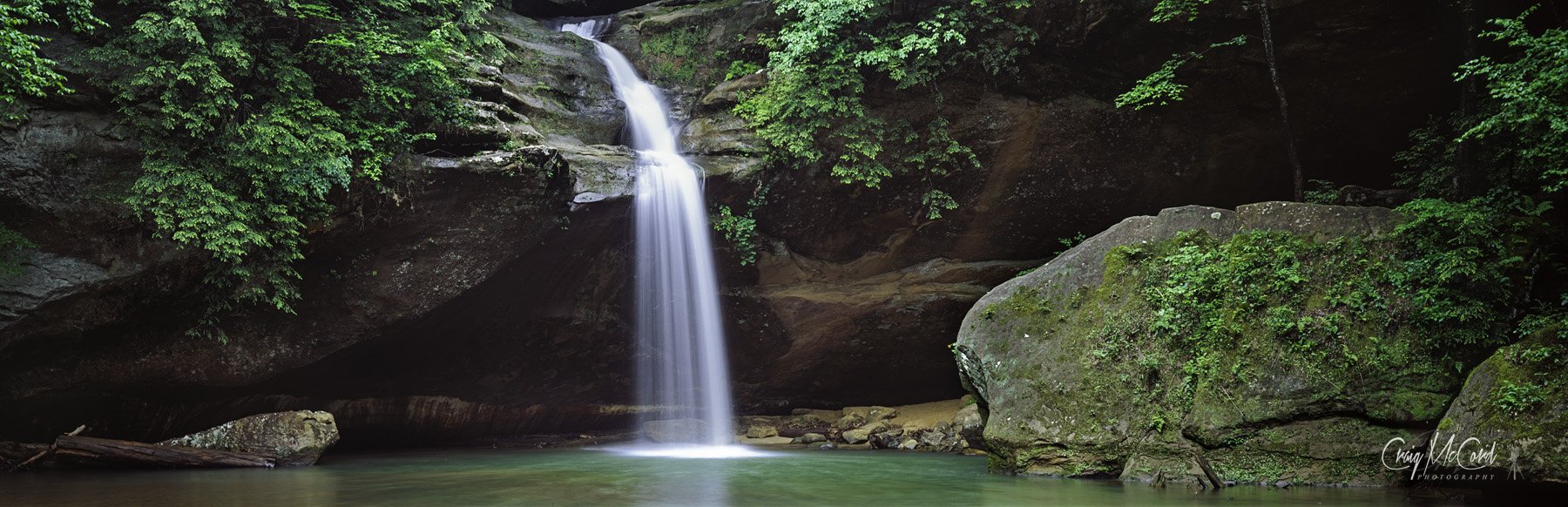
Panoramic of Lower Falls, Shen Hoa PTB 617, Provia 100F, 210mm, 3 sec f/45
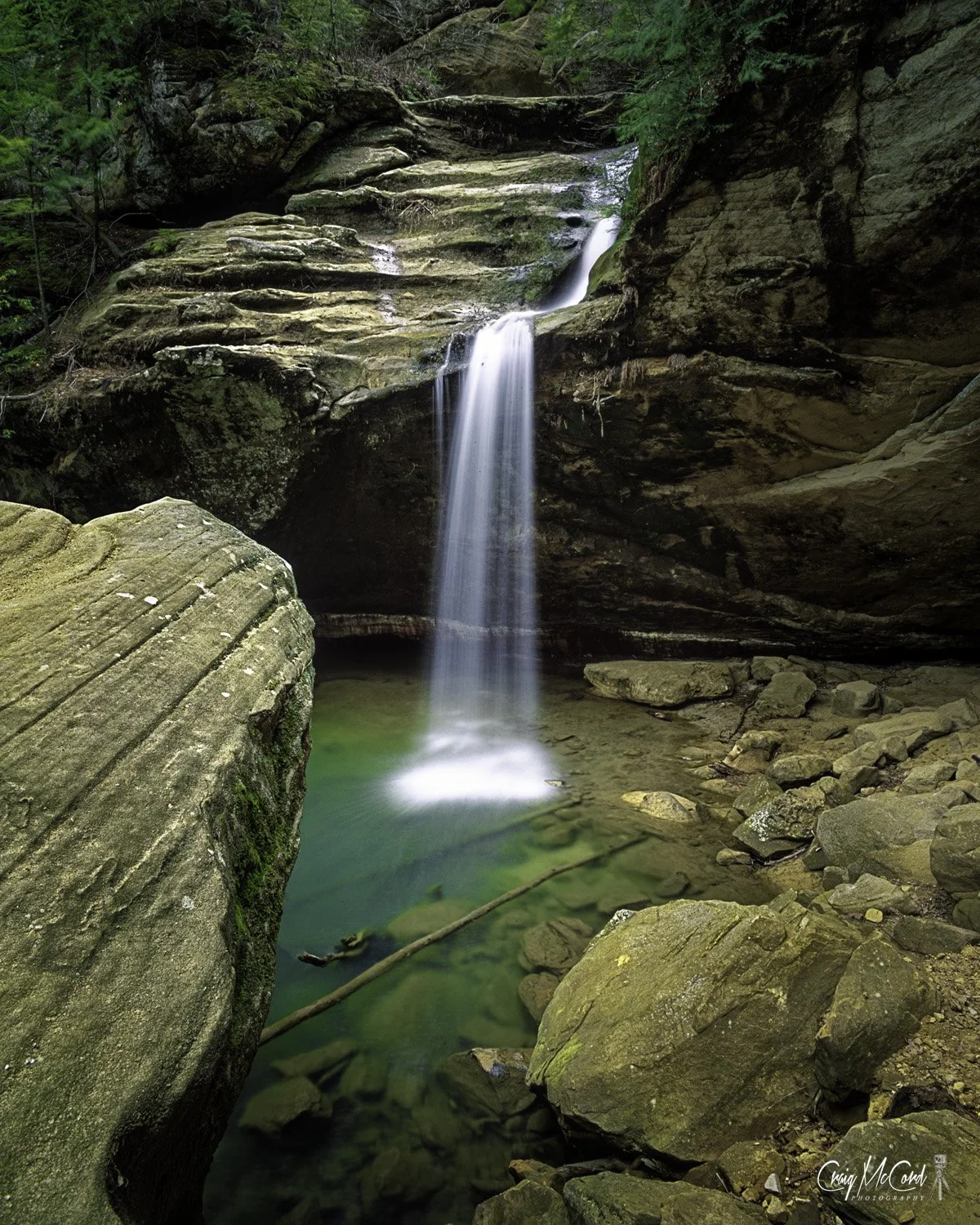
“Lower Falls, Quiet Descent”
Along the trail, you will ultimately come to the serene Lower Falls—a quiet yet striking destination nestled deep within the gorge. Unlike Upper Falls, which spills gently in a tiered cascade over broad sandstone ledges, Lower Falls plunges more directly and forcefully from a narrow channel, carving its way into a rocky basin below. The vertical drop creates a smooth, silken flow that contrasts with the jagged textures of the surrounding stone. Moss-covered boulders and forest debris gather at the pool’s edge, softening the scene with organic stillness. Here, erosion speaks in a single breath—less layered, more immediate—offering a moment of quiet descent where water meets stone with clarity and grace.
What Next
Well, I could easily keep going on because this entire region is truly a treasure trove, filled with breathtaking beauty and countless photographic opportunities waiting to be discovered. However, I plan to share a few subsequent posts that will focus specifically on additional locations in the area that everyone should consider exploring. I sincerely hope you will follow along and enjoy the journey as much as I do.